Personalized Software: When AI Turns Users into Co-Developers
January 4, 2026
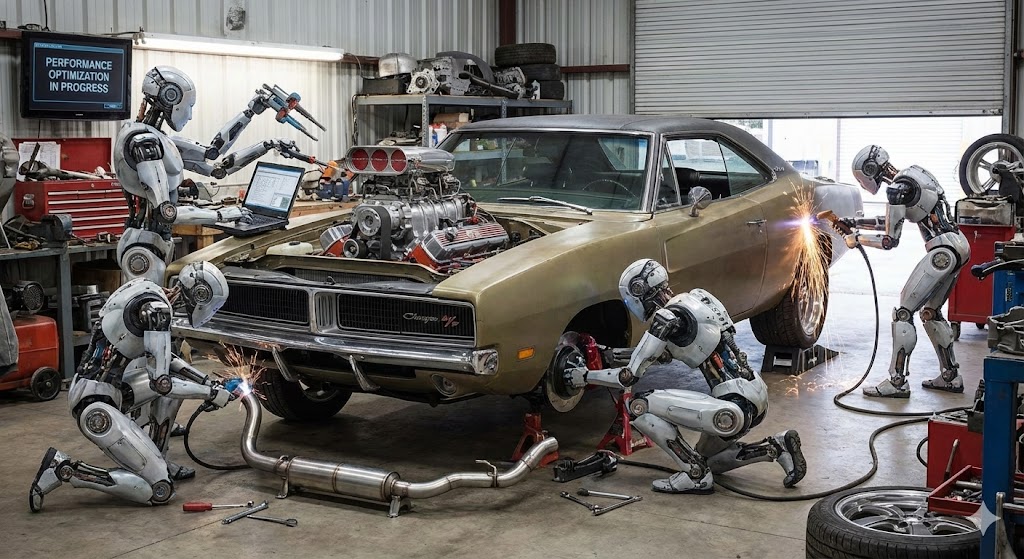
For much of the last two decades, software has been treated as an appliance: sealed, optimized, and hostile to modification. Applications arrived as finished products—black boxes designed for passive consumption rather than active adaptation. If a tool did not fit a user's workflow, the burden fell on the user to contort their habits around the software, not the other way around.
This "appliance model" was not accidental. It emerged from the economic logic of SaaS, mobile app stores, and subscription-based business models that favor standardization, lock-in, and predictable support costs. In the process, a sharp divide formed: a small priesthood of professional developers on one side, and a vast population of users with little to no agency over the digital tools they depend on daily.
AI is now reopening that divide.
A convergence of large language models, autonomous coding agents, and computer-use systems is reviving an older, almost forgotten vision of computing: software as a malleable medium. Instead of fixed artifacts, applications increasingly behave like computational clay—substrates that users can reshape, extend, and recombine to fit their own needs. This shift marks the emergence of Personalized Software, where the boundary between using and authoring begins to dissolve.
From Appliances Back to Materials
Early visions of personal computing imagined software as something closer to a creative material than an industrial product. Like wood or clay, it could be shaped, repaired, and repurposed by its owner. Over time, however, economic incentives pushed software toward rigidity. Walled gardens, proprietary formats, and sealed binaries turned general-purpose computers into consumption devices.
Researchers describe the result as a world full of "nightmare bicycles": tools that technically work but resist adaptation, leaving users frustrated and powerless. Traditional customization options—preferences panels, themes, or plugins—offer only superficial relief. They tweak the surface without restoring real agency.
Personalized Software challenges this model at a structural level. It is not about more settings or darker dark modes. It is about restoring the user's ability to edit their tools, just as they edit documents or spreadsheets.
Phase 1: Configuration as a Conversational Interface
The first wave of this shift is already familiar to developers.
Configuration files—Neovim setups, tmux layouts, shell aliases, window manager rules—have long been the entry point to personalization. What AI changes is not the existence of configuration, but who can effectively use it.
Instead of memorizing syntax, APIs, or plugin ecosystems, users can now express intent in natural language:
"Make my editor minimal, optimized for Python, with fast navigation and no visual noise."
AI systems translate that intent into working configuration, iterate on it, and explain trade-offs. This lowers the activation energy of personalization dramatically. Configuration stops being an arcane skill and becomes an accessible interface.
At this stage, personalization still operates within vendor-approved boundaries. But it primes users for something deeper.
Phase 2: Source Code as a User-Editable Surface
Once configuration reaches its limits, the next logical step is modifying the software itself.
Historically, this required deep familiarity with a codebase, its architecture, and its build system. That friction excluded almost everyone except seasoned engineers. AI agents remove much of this friction.
Modern systems can:
- Navigate unfamiliar repositories
- Build mental models of large codebases
- Propose localized patches instead of full rewrites
- Refactor behavior while preserving style and intent
- Act as "local developers" embedded inside the tool
This aligns with what researchers call the Outer Loop of interaction: a meta-layer where users modify the tool itself, while the Inner Loop—the normal GUI or workflow—remains fast and direct. AI excels in this outer loop, translating fuzzy human intent into precise structural changes without interrupting flow.
The result is that large, mature applications become locally editable again. Software is no longer something you merely choose between—it is something you adapt.
Phase 3: Personalization Without Source Code
A common assumption is that personalization stops at open source. That assumption is increasingly fragile.
AI is rapidly improving at reverse engineering, decompilation, and dynamic analysis. Where traditional tools produced unreadable pseudo-code, modern AI systems reconstruct meaningful, idiomatic logic from stripped binaries. They infer variable names, simplify obfuscated control flow, and even suggest patches.
Combined with "computer-use" agents—systems that interact with software through the GUI just like a human—this enables a new kind of superficial malleability. Even closed, proprietary applications can be wrapped, automated, and reshaped without official APIs or source access. The software remains sealed, but the experience becomes programmable.
Over time, the distinction between open and closed software may shift from a technical boundary to a legal one.
Friction, Law, and the Limits of Malleability
This shift does not come without resistance.
Legal frameworks built for the appliance era—copyright, anti-circumvention laws, restrictive licenses—collide directly with user-driven modification. At the same time, malleability introduces real risks: security vulnerabilities, stability issues, and the challenge of reconciling personalized forks with upstream updates.
Researchers highlight emerging mitigation strategies: AI-assisted merge systems that reconcile user modifications with upstream releases, universal version control models for application state, sandboxed agents, and verification frameworks that validate AI-generated changes before they ship.
Without these safeguards, personalization risks collapsing under its own complexity.
Toward a World of Computational Crafters
The convergence of AI agents, reverse engineering, and local-first thinking is driving a renaissance of user agency. We are moving from passive consumption of digital appliances toward active co-creation with computational materials.
If this trajectory holds, the category of "user" itself may fade. In its place emerges something closer to a computational crafter—someone who shapes their tools continuously, with AI acting as a collaborator rather than a replacement.
In that sense, Personalized Software is not a break from the history of computing. It is a return to what personal computing was always meant to be.
Explore the interactive version of this essay for visualizations and deeper insights.